

When I put together a dog training plan for one of my dogs, there’s a lot I consider before I ever get my dog and start training.
Now, I hope I’m not going to scare you when I say that! A dog training plan doesn’t need to make training complicated. Quite the opposite. The reason I plan is so that once my dog and I start, the training can be seamless and I can focus on the dog in front of me.
Whether I’m teaching a hand target, loose leash walking, agility or working through a Recallers game, I want to know what I’m training today and how I’m going to set my dog up for success.
For my own dogs and for students in our online programs, there are 10 elements I consider. Some are big-picture decisions and others might seem like little details, but every one helps me be more intentional about the training.
So, let’s get started.
1. Know Your Criteria For The Finished Behavior
The first element of my dog training plan is criteria.
What is the final product?
Your criteria will be unique to the exercise you’re teaching. If I’m training a sit stay, I might care about duration or distance away from me. When I’m doing agility, I care where my dog is looking. When I’m doing loose leash walking, I really don’t care where my dog is looking. Competition Obedience? You betcha, I care where my dog is looking.
So you have to decide what matters for the behavior you’re training. And remember, the more details you add to your criteria, the longer it will take to train and the harder it will be to maintain.
Know what you ultimately want, including what you don’t want to become part of the behavior. I call those superstitious behaviors. Those are things I don’t want creeping into what I’m training.
Maybe it’s barking. Maybe your dog has a superstitious behavior like spinning. I want those behaviors in the forefront of my mind so I know not to mark and reinforce near them. They may also be telling me that my dog is frustrated, and that means I need to alter my protocol.
2. Decide What Slice You’re Training Today
We know what the finished product looks like, but we’re not going to train the whole finished product in one setting.
So the second element is: What is the criteria of the slice I’m training today?
If I’m teaching loose leash walking, I might just be creating value for Reinforcement Zone at my side. There are several steps involved in loose leash walking, but today I can train one little layer.
We do all our training in layers.
The same is true in Recallers. One game might be working on one little slice to help build confidence or create a positive conditioned emotional response. A game you work on later might be maximizing the reinforcement that comes through you.
Different games can work on different parts of the bigger goal.
That’s why I don’t need to train everything today. I need to know the slice I’m training today.
3. Manipulate The Training Environment
Number three is a biggie: environmental manipulation.
How do you create the ideal environment for your dog to have success in the training?
Start with where you’re planning to train and do an inventory of the distractions naturally present.
How big is the area? What surface will your dog be working on? Are there other dogs or people? Could there be wildlife? What smells are in that environment?
If you have a dog who is naturally driven and reinforced by really good smells, those smells need to be considered one of your big distractions.
And throughout all of this, consider your dog’s age and stage.
At 17 weeks old, my puppy could work in our big training building with its 11,000-square-foot training floor. Three weeks earlier, that might have been way too much for her. I would have needed to manipulate the environment, maybe using baby gates to create a smaller area where she could be successful.
Another 17-week-old puppy might not be ready for that building at all.
That’s why there isn’t one perfect training environment for every dog. The environment has to support the dog you have and the criteria you’re working on today.
Should You Decrease Or Increase Distractions?
Sometimes your dog training plan needs to decrease the distraction value. That might mean training in a smaller, less distracting space. In a new environment, your dog might be on leash with a harness or collar, or you could use an ex-pen or baby gates to make the training area smaller. At a training facility, I might use an agility tunnel to create a physical barrier in a corner.
Even if other dogs are nearby, my puppy might not be able to see their movement, which immediately reduces some of that distraction value.
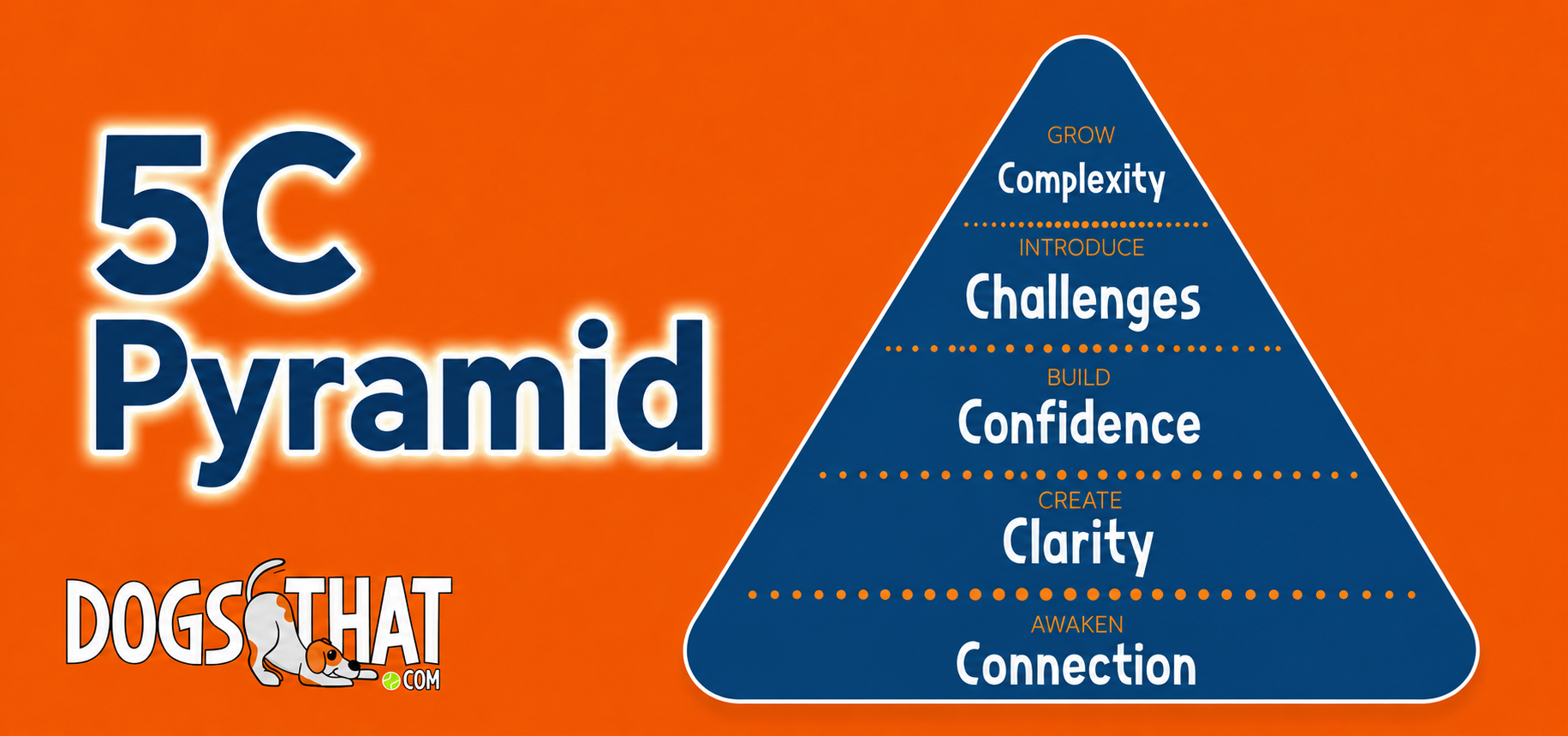
Other times, your dog may be ready for you to intentionally increase the distraction. This is where the 5Cs come in. Once we have Connection, Clarity and Confidence, we can introduce some Challenge and begin growing our dog’s Capability.
With my puppy, that might mean another dog simply lying in the Hot Zone while she works. Eventually, that dog might be walking around. From there, you can gradually grow the distractions by training in another room, moving into your yard, or choosing a quiet location away from home. Over time, you might work somewhere with a little more going on, like a quiet city street.
Remember, new always trumps the norm when we’re talking about distraction, so even a small change in environment can add challenge. The important question is: Is my dog ready for this? Growing distractions should be intentional and based on what the dog in front of you is ready for today.
4. Choose The Reinforcement You’ll Use
Element four is the type of reinforcement you’re taking into your training.
Based on your criteria and the distractions, do you need super high value food? Will you use toys? What behaviors are very reinforcing to your dog that you can use in today’s training?
This is why the order of the dog training plan matters.
I know my criteria. I know the slice I’m working on and the environment I’ll be training in. Now I can make a thoughtful decision about reinforcement.
I’m not just grabbing some cookies and hoping for the best.
5. Plan Your Props And Warmup
Element five is props.
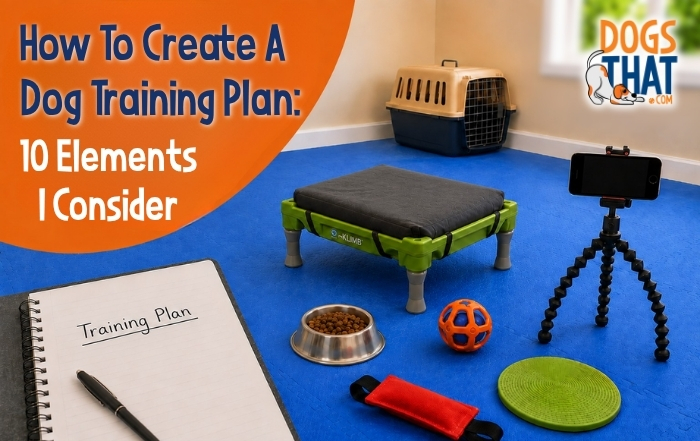
Are you using a crate? Will you use a Hot Zone, like a bed your dog can jump up on? Are there targets involved?
There will be different props and targets depending on what I’m training. Pet dog training might need one setup. Agility or another dog sport might need something different. Fitness will have its own props.
I also think about my warmup.
If I know I’m going to be working on behavior X, I can say, “Oh yeah, I’ll need this as my warmup.” Then I know what prop I need to warm my dog up before jumping into that training.
Again, we’re planning before we get the dog.
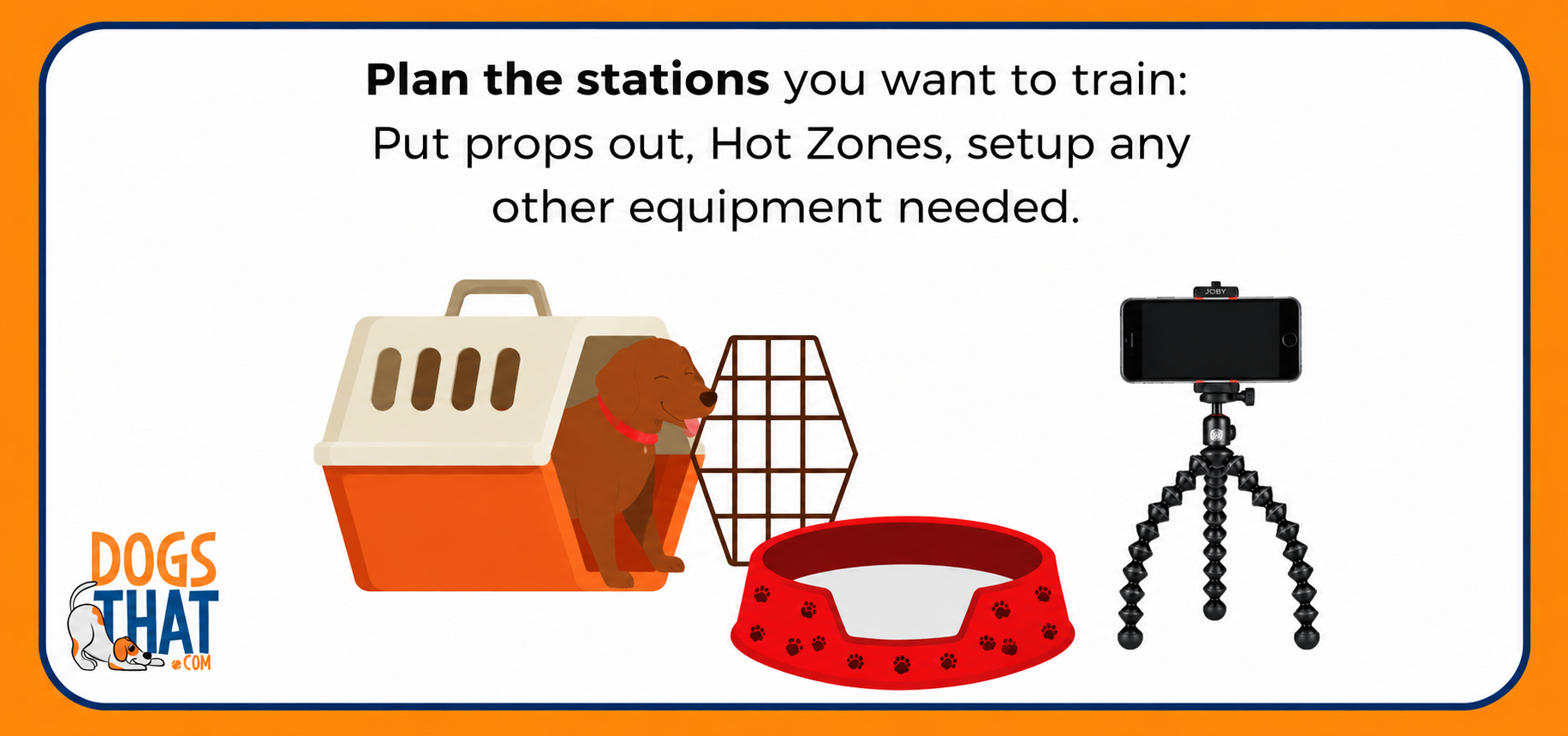
6. Decide Where Everything Will Go
Next, where will everything be placed?
Where is the best location for my video camera? Where will the crate go? Where will my Hot Zone be if I’m using one? And where will I put my reinforcement?
I’ll use cookies in a bowl and keep them on the floor. I might have a toy around my neck or one in my back pocket. I can have other reinforcement in the environment that I can grab and immediately go into a game with my dog.
I strategically plan those reinforcements based on what I have planned for today’s slice.
These might seem like little details, but when they’re decided ahead of time, I don’t have to figure them out while my dog is waiting for me.
7. Put Balance Breaks Into Your Dog Training Plan
What will you do for balance breaks?
This is closely related to reinforcement because I want to be very intentional about my dog’s arousal state. I want to use games that create a change in my dog’s physiology before I train, during my balance breaks and after training.
The key is that I plan those breaks.
I don’t play a little game of retrieve until my dog starts getting slower and then suddenly think, “Oh yeah, I should do one of those balance breaks.”
That is not the time to take the break.
I want to do it while my dog is still enjoying what we’re doing.
8. Plan How You’ll Transition
The next element is transitions.
I train in stations. My warmup is always something to do with fitness, and then I transition into whatever I’m going to work on. I might have the training split into different stations.
So, how will my dog and I move between them?
Sometimes I’ll ask my dog to “hop it up” into the Hot Zone while I take notes about what just happened. I might take a longer break and look at the training I just recorded.
Quite often, I’ll use a Recallers game or tug game to move from one station to another.
The point is to be intentional about what happens between the pieces of your training, too.
9. Remember What Is Always In Play
There are also things I want in the back of my mind throughout every training session.
For me, one of those is ItsYerChoice, whether that involves food, toys or people coming in and out of the room.
And as my mentor Bob Bailey says, “Pavlov is always on your shoulder.”
Be aware of what you might be conditioning inadvertently when you use reinforcement.
Pay attention to your dog’s body language and emotional state. If your dog is worried about a piece of equipment, that matters. If one of those superstitious behaviors appears, that matters too.
Your dog gives you information throughout the training. They’re the ones who drive the training for you.
10. Get Your Dog, Execute And Review
And finally, after all that, you get your dog.
Now you execute your dog training plan.
But there’s one more important piece: review what you just did.
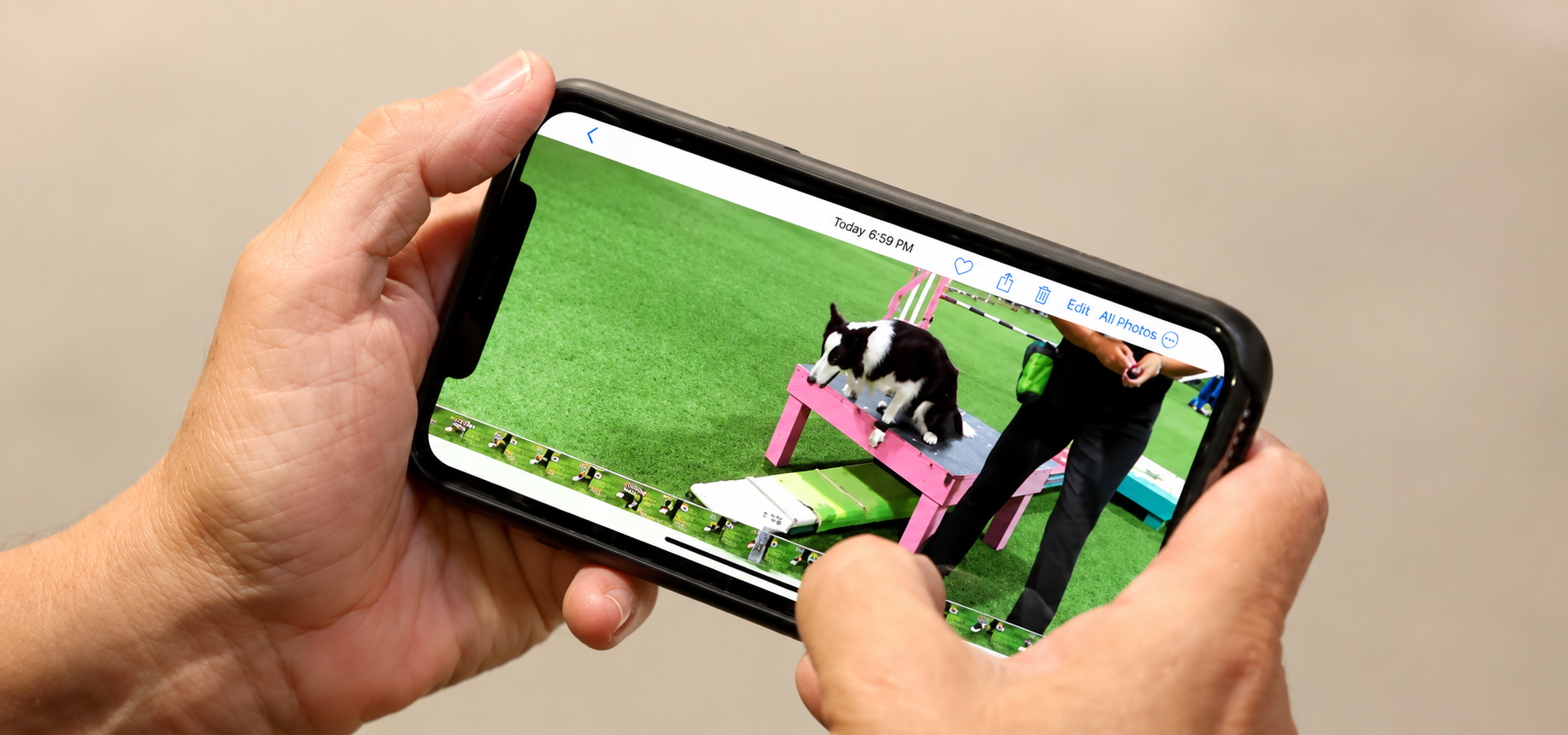
I look at my video and my training notes. That review gives me information about what happened and helps me decide what needs to change when I plan the next session.
The training plan isn’t there to lock you into doing something because you wrote it down.
Your dog is always giving you information. Your review lets that information shape what you do next.
The Big Picture: Be Intentional About Your Dog Training
That’s how I take the goals I have for training and turn them into an actual dog training protocol. Every single thing is planned.
Whether I’m teaching a hand target or something far more involved, I want to be intentional about the state of arousal I want when my dog is first learning and what I want when I’m growing the game.
Being intentional doesn’t mean training becomes rigid or complicated. It means I’ve thought about what I’m training before I get my dog. I’ve considered the environment and what my dog needs at this age and stage. I’ve planned the details that will help the session flow.
Then I watch the dog in front of me.
That makes for seamless training. It makes for happy dogs. And it makes for a fun training environment.
Frequently Asked Questions About Creating A Dog Training Plan
What is a dog training plan?
A dog training plan is a way of deciding what you want to teach and how you’ll set your dog up for success before you start training. It considers the behavior you’re working toward, what you’ll focus on in today’s session, and what your dog needs at their current age and stage. The plan also helps you be intentional about the training environment and how you’ll respond to the information your dog gives you along the way.
Why should I make a dog training plan?
A dog training plan helps you be intentional before you start training. Rather than making decisions while your dog is waiting, you can plan the criteria, environment, and other details ahead of time. That gives you more opportunity to focus on your dog and adjust according to the information they give you.
How do I start a dog training plan?
Start with the final product. Decide what the finished behavior looks like, including any behaviors you don’t want becoming part of it. Then decide what small slice of that finished behavior you’re going to train today.
How do I choose the right environment for dog training?
Do an inventory of the environment’s distraction value. Consider the size and surface of the area and what your dog may see, hear, or smell. Then decide whether you need to decrease distraction or whether your dog has enough connection, clarity and confidence for you to intentionally add challenge.
Should a dog training plan change?
Absolutely. Your dog drives the training. Pay attention to their body language and emotional state while you train, then review your video and notes afterward. What you learn from one session can help shape your plan for the next.
Gratitude
Today I’m grateful for the information our dogs give us every time we train. We can make a plan and be super intentional about what we want to teach, but the dog in front of us will always tell us what they need next.
I’m grateful that planning doesn’t have to take the joy or spontaneity out of training. Done thoughtfully, it gives us the opportunity to create seamless training, happy dogs, and a fun environment where learning can grow.
🎉 P.S. I’ve got something brand new coming that I’m super excited about, the Recallers Archetype Series. It’s a free series where I’ll help you better understand your dog and how that understanding can shape the way you teach and train together. And it all starts with Vito’s Thinking Game. Get the game for free today, start noticing how your dog thinks and makes choices, and I’ll build on what you discover when the Archetype Series begins.
Already know Vito’s Thinking Game? You’ll still want to jump in! I’ve recorded all-new content around the game especially for this series, so there’s something new waiting for you and your dog. 🎉





Taking videos of my training to review later is so useful! Thank you for the reminder to film often—I really saw the benefits of it today.
Thank you for the breakdown. It’s good advice and I’ve definitely been getting much better with my planning through Recallers.
As a novice trainer one of the hardest is step 1: Knowing exactly what the final behavior looks like, how to make layers, and how to avoid unwanted behavior creep (the superstitions).
Recallers is helpful because it’s already set up in layers. Even there my criteria can get sloppy but it is helping me understand layering and incremental improvements.
I’m a useless planner. Never been able to stick to a plan
Something always seems to derail it and I loose confidence. At present I’m trying to teach a high5 as a rehab exercise for Zac’s shoulder but he just keeps offering a nose touch which is well trained! So I give up !
Thank you
Really helpful information to help me devise a training plan .
This is one area that I most definitely need to put time and thought into .
This is great information and really helps get me organized when setting up my sessions.