

If your dog is eating poop, it’s usually not just a behavior problem.
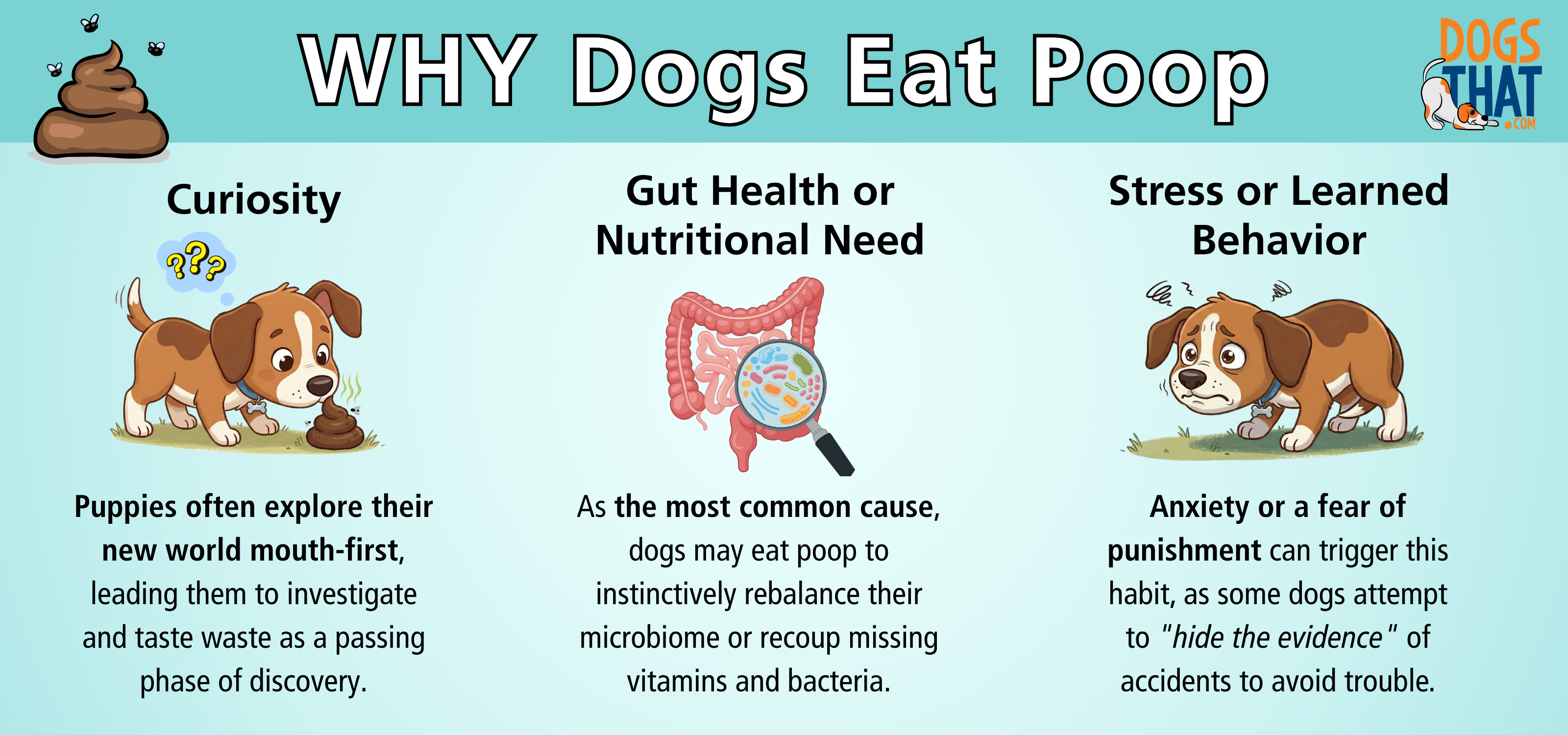
Dogs eat poop most commonly for one of three reasons: curiosity, especially in puppies; stress or learned behavior; or an internal imbalance, often related to gut health or how their body is processing food. This behavior, also known as canine coprophagia, is more common than most people realize.
While it can be a temporary phase, especially in puppies, it can also be a sign your dog is trying to rebalance something in their system.
That’s why simply trying to stop it often doesn’t get you very far.
When you take a step back and look at why it’s happening, you start to see there’s useful information in it. And once you understand that, it becomes much clearer how to help your dog in a way that actually works.
Why Dogs Eat Poop:
There are three main reasons this can happen.
1. Curiosity
With puppies, this can simply be a phase. Everything is new. They explore with their mouth, and poop can be something they investigate.
2. Gut Health or Nutritional Need
This is the most common reason.
Your dog may be missing something. It could be related to their microbiome, a vitamin, or bacteria their body needs. Eating poop may be their body’s way of trying to rebalance.
3. Stress or Learned Behavior
In some cases, dogs may eat poop due to anxiety. For example, if a dog has been punished for accidents, they may try to remove the evidence.
This is not the most common cause, but it is important to consider.
What I Saw With My Own Dog
When my young Border Collie, Prophet, came home, he would go looking for poop immediately.
It wasn’t random. It was like he needed it.
That told me this wasn’t about training. I looked at it as feedback.
I started researching and introduced a probiotic that supports gut health. The one I used was Soil & Sea by Adored Beast.
Within 48 hours, he stopped showing interest in eating poop.
Later, when I switched him to a different probiotic, the behavior came back briefly. That told me this was about his system, not his training.
Why Trying to Stop It Can Backfire
If you focus only on stopping the behavior, you might:
- correct your dog
- chase them away from poop
- use products to make poop taste bad
But this does not solve the problem.
In many cases, your dog simply learns not to do it when you are watching. They get better at being sneaky.
And if stress is part of the cause, correction can make it worse.
What You Can Do
-
Manage the Situation
- Take your dog out on leash.
- Choose areas that are clean.
- Pick up any poop in your yard or where your dog is likely to go.
This prevents rehearsal while you figure out the cause.
-
Look at Your Dog’s Health
If your dog is eating poop, consider what might be missing.
You may want to:
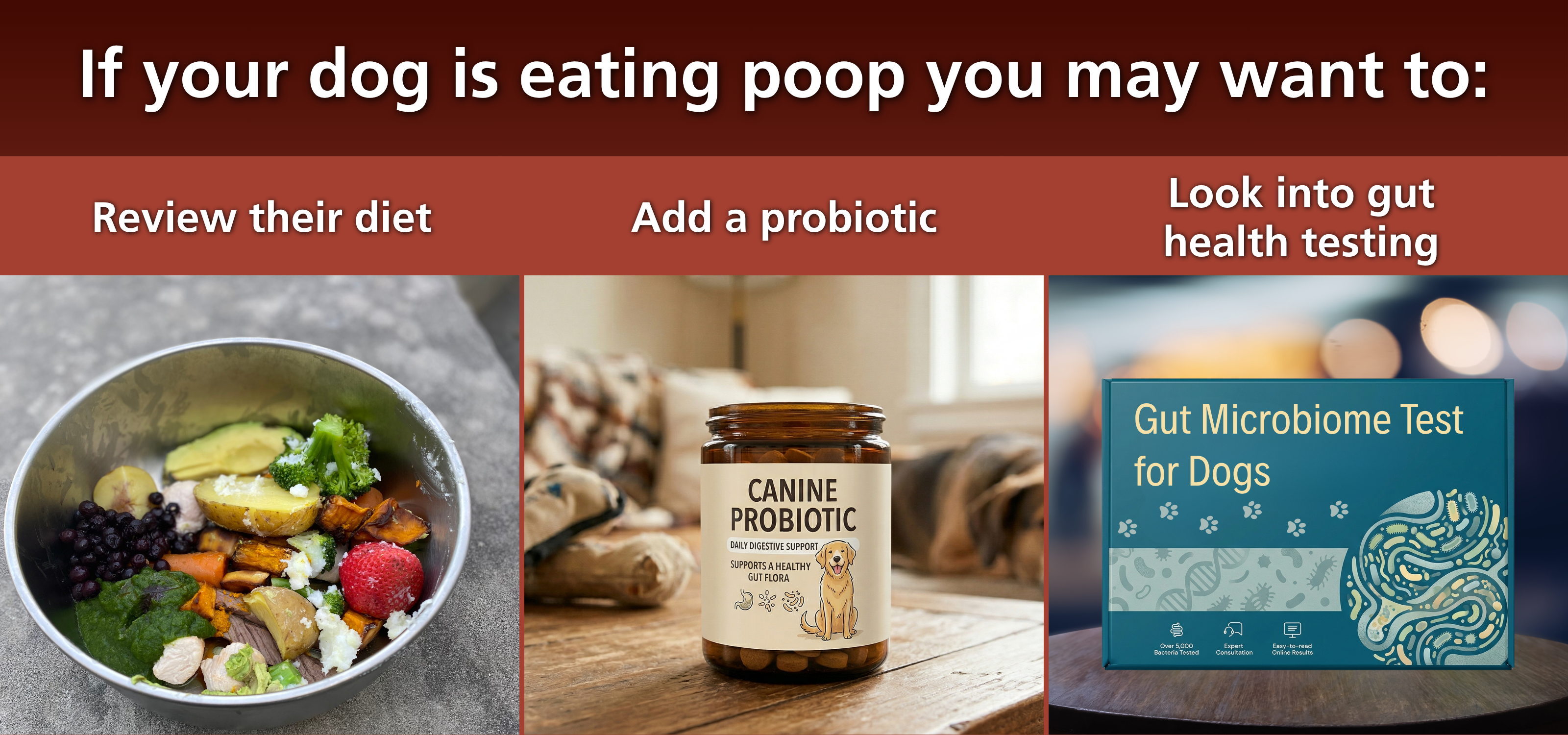
- review their diet
- add a probiotic
- look into gut health testing
Note: You might want to dig a little deeper and see what’s going on inside your dog. I’ve used hair analysis through Dr. Dobias and gut biome testing through VDI Laboratory to get a better idea of what might be missing for my dogs, and they’re options I can confidently recommend looking into if you want more understanding around what your dog might need.
-
Avoid Punishment
Telling your dog off does not teach them what to do instead. It often adds excitement or stress, and it can turn the behavior into a game of “don’t get caught.”
Remember, this behavior is information.
-
Use Training to Support
You can build value for ignoring things on the ground through games like ItsYerChoice.
But if there is a biological reason, training alone will not fix it. You need to address what is happening inside your dog. If you are unsure, or if the behavior continues, it is important to consult with your veterinarian or a qualified canine nutrition professional to rule out underlying health concerns and guide you in supporting your dog appropriately.
The Big Picture
A dog eating poop is not about a dog being bad.
It is a signal.
When you see it as feedback, you open the door to solving the real problem. That might be a phase. It might be stress. Often, it is something happening in the gut.
Your job is not to shut the behavior down.
Your job is to understand why it is happening and help your dog.
Today I Am Grateful
Today I am grateful for the moments that push us to look beyond the surface of what our dogs are doing.
Even something as uncomfortable as a dog eating poop can be a reminder that our dogs are always communicating with us.
When we pause instead of reacting, we give ourselves the chance to understand what might be going on underneath, whether that’s a need, an imbalance, or something we can support them through.
When we choose to listen instead of judge, we don’t just change a behavior. We become better for our dogs in the ways that matter most.




I am very grateful for your consistent , thorough and balanced teaching Susan . I often get busy and fall behind with my recaller program and watching your regular email posts. Really notice how quickly I drift of what is important. when I do that. So appreciate you bringing me back to what is the most important thing……….understanding what your dogs behaviour is telling you.
God bless you in all that you do for dog owners. Makes our life and our dogs life so much better. Regards Julie-ann Otago ,
New Zealand.
Kinda on this topic. My put had poor nutrition his first 17 weeks of life. I transitioned him to home made raw using recipes from forever dog. Things really improved. Then my vet really encouraged me to put him on a high end flee tick and heart worm monthly. I was taking him on a two month trip to the Pacific Northwest. The first tablet he started vomiting for two days and recovered. The second he vomited right away. The third he refused. As I was breaking it to put down his throat I thought what am I doing this obviously is not for him. So that day he got a third of a tablet and vomited two hours later.
I noticed his fears and shyness , emotional sensitivity has skyrocketed during this time. He has decreased his food intake often refusing the raw food and opting for only his high value training treats.
What do you do for flee tick and heartworm?
This is the first time I have used this product on my dogs. But also my last two dogs both suffered from Lyme disease, that’s my reason for trying oral treatment
Clearly this little guy needs to go back in just plain heart guard.
And yes he did start learning poop in last three months
Thanks for any ideas
My dog has been a poop eater since he was a puppy — now just over 1 year old. We have been managing it by picking up poop as soon as it happens, but it seems to have become a game– who can get to the poop first. I recently started a pre/probiotic supplement. How long does it take for that to work?
Love your information ! Thank you
Thank you for this timely info . I have a young dog 7 months old who just started this in the last month, more licking at this point but concerned it will get to the point where she is eating other dogs poop. I was wondering what was going on . It is only when the poop is freshly expelled older poop does not interest her. I will be looking at some probiotics for her
What about interest in poop of other animals? Squirrel or rabbit droppings are difficult to observe and remove. Is this likely to be curiosity? Is there a way to apply “ItsYerChoice” for this?