

Thinking about bringing home two puppies at the same time? It sounds wonderful, doesn’t it? The idea of two puppies growing up together can feel really special.
But I’m going to be honest with you. For most families, bringing home two puppies together is something I strongly advise against. It is one of the most common challenges I see, and it can make raising confident, well-adjusted dogs far more difficult than people expect.
Puppies are incredibly social, and when two or more grow up side by side, they naturally form a powerful bond with each other. Often that bond develops much faster, and much stronger, than the one they build with their humans.
When that happens, we can see a pattern of behavior commonly referred to as littermate syndrome.
Littermate syndrome occurs when two puppies, whether they are biological siblings or just similarly aged, form an intense and codependent bond that hinders their individual development. This deep reliance often leads to separation distress and a lack of confidence because the “sibling bubble” becomes far more reinforcing than anything we offer in our training.
Why Reinforcement Matters
To raise a confident family dog, we want our puppies to learn that the most important relationship in their world is the one they have with us. But when the most exciting thing in a puppy’s world is always their sibling, it creates a “reinforcement bubble” that can make it so much harder for us to connect. It creates real training challenges that can stand in the way of the clear communication and deep partnership we want for every dog
A quick note before we go further: if you’re seeing signs of aggression, ongoing distress, or behavior that feels beyond your comfort level, please reach out to a qualified professional. A certified Veterinary Behaviorist can give you guidance tailored specifically to your puppy.
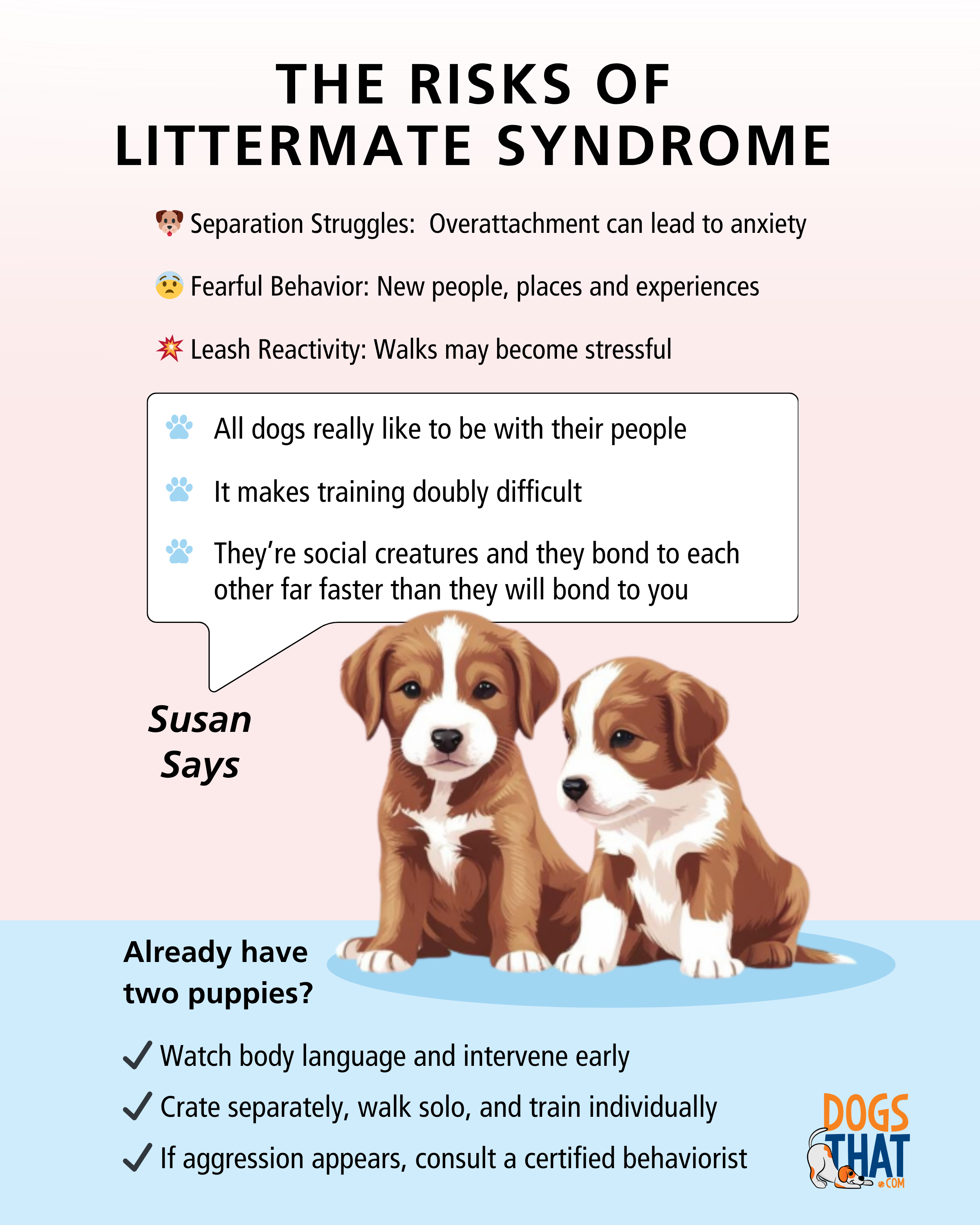
Why “Double the Love” Can Lead to Trouble
When puppies spend every waking moment together, they do not get the chance to develop independence. Instead of learning how to navigate the world on their own, they rely heavily on each other.
Over time, that can lead to several common challenges:
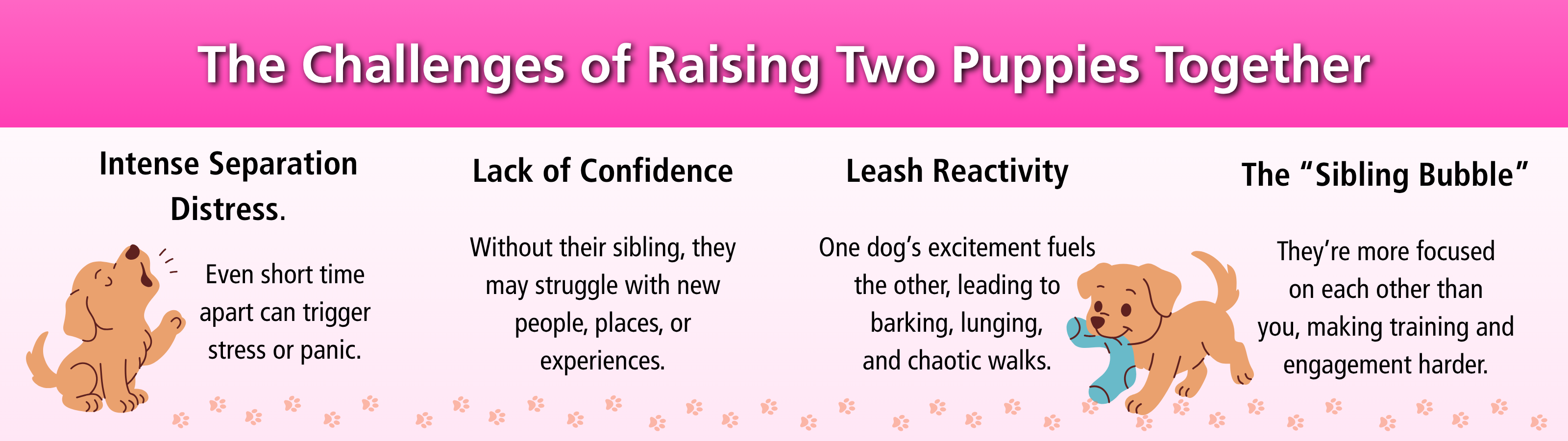
Intense Separation Distress
When puppies become overly dependent on one another, even short separations can be stressful. Being apart, even for a few minutes, can trigger panic or distress.
Lack of Confidence
Many littermate pairs rely on each other for emotional security. Without that familiar partner nearby, they may struggle to handle new people, environments, or experiences.
Leash Reactivity
Two puppies feeding off each other’s excitement can quickly escalate into barking, lunging, and chaotic walks. One dog’s emotional response amplifies the other’s.
The “Sibling Bubble”
Perhaps the biggest challenge is engagement. When the most exciting thing in the world is their sibling, it becomes difficult for us to compete for their attention during training.
They simply do not need us the way we want them to.
Already Have Two Puppies? Here’s How to Help Them Thrive
If you already have two puppies at home, do not panic.
It simply means being more intentional about helping each dog develop their own identity and independence. It takes more time and planning, but it is absolutely possible to raise two confident, happy dogs.
Here are a few strategies that can make a big difference.
Create Separate Calm Spaces
Each puppy should have their own crate or safe relaxation area. A place where they can settle independently.
I often refer to this as a Hot Zone, where a dog learns how to relax and calm down. Separating puppies during rest times prevents them from constantly reinforcing each other’s energy and helps develop a vital off switch.
Train One Puppy at a Time
Clarity matters in training, and trying to teach two puppies at once usually leads to confusion.
Instead, use short training bursts, what I like to call Daily Quickies, with one puppy while the other rests in their crate. Even 60 to 90 seconds of focused training builds connection, communication, and understanding.
Take Individual Walks
Walking together may seem convenient, but separate walks are far more valuable.
When puppies walk alone with you, they learn to pay attention to your guidance rather than reacting to their sibling’s emotions.
This builds engagement, confidence, and calmer leash skills.
Watch Their Communication
Become a student of your puppies’ body language.
If you notice one dog consistently overpowering the other, or one becoming timid or hesitant, step in early. Manage the environment and create opportunities for each dog to experience success independently.

The Big Picture
Raising two puppies together is not impossible. But it requires far more time, structure, and intention than most people expect.
Our goal is not to weaken the bond between siblings. It is to make sure each puppy also develops confidence, independence, and a strong relationship with us.
When dogs learn they can navigate the world on their own, and with us as their guide, that is when true confidence begins to grow.
Today I Am Grateful
Today I am grateful for the individuality each dog brings into our lives. Every puppy has their own personality and their own way of connecting with us.
When we take the time to nurture that individuality, especially in homes with multiple dogs, we give our dogs the greatest gift possible: the confidence to be themselves.
And that is where the real magic of training begins.





What do you feel is a good time frame between dogs should you want to own two
this is so true. We did that with two sibling puppies, but without having this amazing advice we did train separately. we never did haven issues but the one thing I did notes that the female puppy Zelle never bonded with us as closely as she did with her brother Shaka. He developed the much stronger bonding was easier to train. I have never brought home two again. we loved them all.
Thanks for this. I can’t agree enough. My amazing girl had a wanted litter of three in December. Only one is in my home now, and he will leave before he’s a year old. He’s progressing nicely with HSTD and IYC. His sisters visit often because they belong to family members. And whenever they come, we all experience housetraining setbacks. They do enjoy each other, and it’s much harder to manage them together.
My question is about their mom. She was a fantastic mother and the pups are completely weaned. She plays beautifully with the male puppy that lives with me–sorts him out occasionally, but mostly seems to enjoy him. She is pretty hard on the girls when they visit, though. Resource guards toys, food, etc. Thoughts about how to help her enjoy their visits more? I do plan on having her spayed soon, which may help…I’d like to nip this in the bud. Grateful for any thoughts or podcast recommendations.